This week I wrote a rulebook for this blog. 46 rules. 1 of them is a list of banned words: "delve," "tapestry," "in today's fast-paced world." I write my own posts, and I use AI to edit and polish them. If AI ever suggests one of those words, it gets cut. No discussion.
A few days before that, I gave my AI assistant another rule: no more hearts and emojis in the messages it drafts for my team and my creators. Keep it direct. Keep it professional. Keep it me.
So here's the short answer on how to use AI without sounding like AI: give AI your real voice, your real stories and your real opinions, let it do the heavy lifting on structure and speed, then cut every robot word and edit the final 20% yourself. AI writes the draft. You write the truth.
I run 3 companies with AI as a mom of 3. AI is in almost everything I do. And I still want every word you read from me to sound like me. This is exactly how I do it.
Key takeaways
- People are tired of content that sounds like a machine wrote it, and they trust brands less because of it.
- The fix: feed AI your voice and edit like a human.
- A 1 page voice guide, a banned word list and the 80/20 rule do most of the work.
- Your stories, numbers and opinions are the parts AI can never fake.
Why "AI voice" is costing you trust right now
This topic is everywhere this fall, and for good reason.
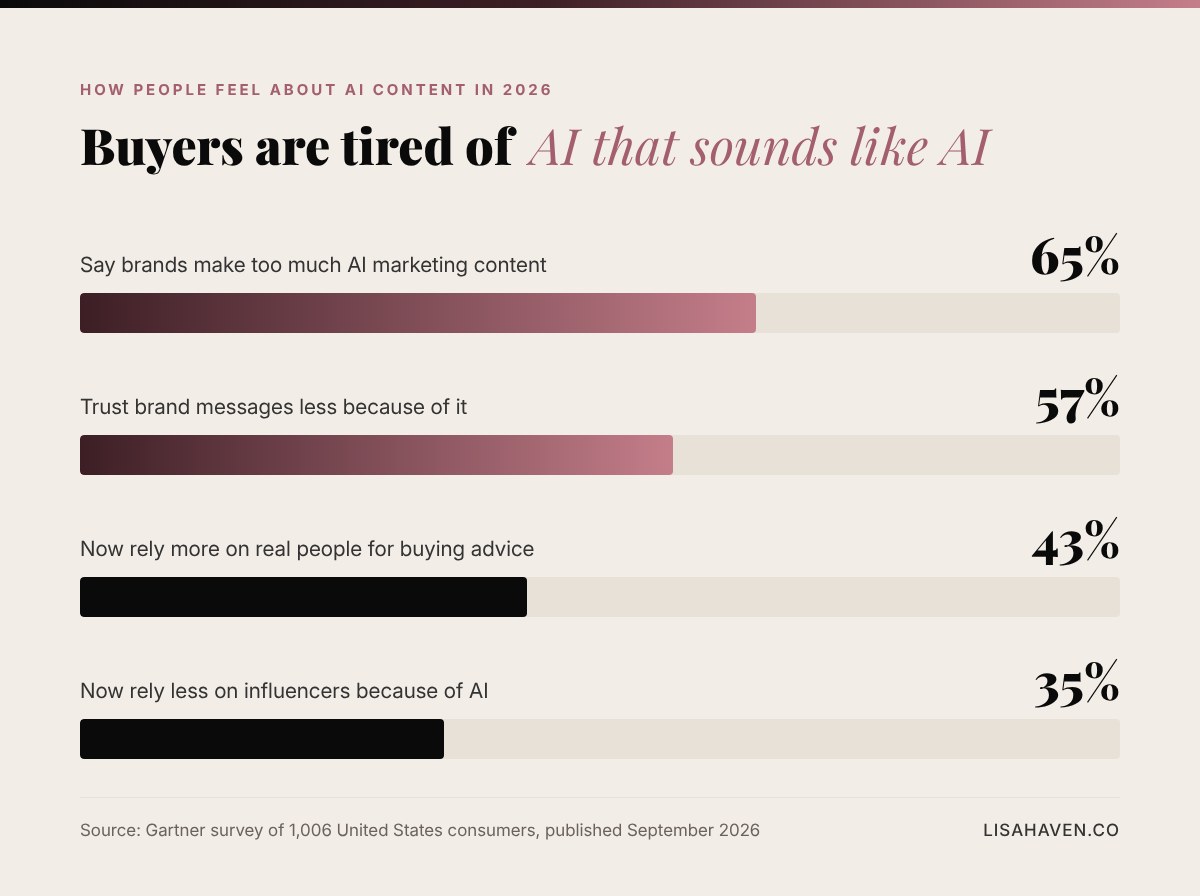
In September, Gartner published a survey of 1,006 United States consumers. 65% said brands are making too much AI generated marketing content, and 57% said it has made them trust brand messages less. 43% said they now rely more on real people when they decide what to buy.
A second report from Clutch, a business reviews company, surveyed 601 consumers in August. 53% said they are less likely to buy from brands they know use AI in their social media content. And nearly 90% said brands should tell people when content is made with AI.
Here's the part most people miss. The same Gartner team did not say "stop using AI." Their advice was to use it thoughtfully. That's the whole game.
What people dislike is content that feels empty. Same words, same rhythm, same fake excitement, no real person behind it.
And here's something surprising: the word for that empty content became official. Merriam-Webster picked "slop" as its 2025 word of the year, with a meaning that points straight at low quality content made in bulk by AI. When a dictionary names your problem, it's time to fix it.
What makes writing sound like AI?
Before you can fix it, you have to spot it. Here are the 6 biggest giveaways I see every single day.
1. Robot words. "Delve." "Tapestry." "Elevate." "Unlock your potential." "Navigate the landscape." Real people don't talk like that over coffee.
2. Fake drama openers. "In today's fast-paced world..." "Let's dive in!" "Buckle up!" These say nothing. Readers skip them, and then they skip you.
3. The same sentence shape, over and over. AI loves a pattern where it tells you what something is not, then what it is. It also loves lists of exactly 3 adjectives. Once you notice it, you see it everywhere.
4. No real details. "Many entrepreneurs struggle with time management." Which entrepreneurs? What happened? A real story beats a general statement every time.
5. No opinion. AI is trained to be balanced. "There are pros and cons to both approaches." Real founders have opinions. Say yours.
6. Too polished. Every paragraph the same length. Every point wrapped up with a bow. Real writing has a little texture. A short line. A strong take. A moment of honesty.
Here's a quick swap chart you can save.
| Sounds like AI | Sounds like a person | |---|---| | "Let's delve into the key strategies." | "Here's what I actually do." | | "In today's fast-paced world..." | Start with what happened this week. | | "Unlock your full potential." | "Get 2 hours of your day back." | | "Navigate the complex landscape." | "Figure out what works." | | "It's important to note that..." | Just say the thing. | | "Elevate your brand." | "Make people remember you." |
How to use AI without sounding like AI: my 7 steps
This is the system I use for blog posts, emails, captions, creator briefs and messages to my team. It works in ChatGPT, Claude or any AI tool.
Step 1. Write a 1 page voice guide
This is the most important step, and almost nobody does it.
A voice guide is 1 page that tells AI how you talk. Mine covers things like: short sentences, direct, warm, honest, confident, numbers written as numerals, no em dashes, and never sounding like a sales pitch.
Here's what to put in yours:
- 5 words that describe how you sound (for example: direct, warm, funny, calm, bold)
- 5 words or phrases you say all the time
- 5 words you would never say
- Who you are writing for, in 1 sentence
- 2 or 3 pieces of writing you love that you wrote yourself
Then paste it at the start of every chat, or save it inside your AI tool's custom instructions or project settings so it loads every time.
Try this prompt to build it:
Here are 3 things I wrote myself: [paste them].

Study how I write. Then write me a 1 page voice guide: my tone, my sentence length, words I use often, words I never use, and how I open and close.

Keep it simple enough to paste into any AI chat.
Step 2. Make a banned word list
This is my favorite trick because it's so simple.
Make a short list of the words and phrases that instantly sound like a robot. Add it to your voice guide. Tell AI: "Never use any word on this list."
Start with these: delve, tapestry, elevate, unlock, navigate, landscape, realm, seamless, game changer, in today's fast-paced world, let's dive in, it's important to note.
Then keep adding. Every time you read a draft and cringe at a word, add it to the list. The longer the list, the better your drafts get.
Step 3. Give AI your story first
AI cannot make up your life. And it should never try.
Before you ask for a draft, give it the raw stuff: what happened, what you felt, what you decided and what the numbers were. Messy is fine. Voice notes are fine. Typos are fine.
Here's the prompt I use:
Here's what happened this week in my own words: [paste].

Turn this into a [post / email / caption] for [who it's for]. Keep my real details and my opinions.

Do not add any facts, stories or numbers I did not give you.
That last sentence matters. AI sometimes fills gaps with made up details that sound nice. One fake detail can cost you trust you spent years building.
If you want to get better at asking AI for exactly what you need, read my guide on how to ask ChatGPT better questions.
Step 4. Let AI build the structure, not the soul
Here's where AI shines. It is amazing at the boring parts:
- Turning a messy brain dump into a clean outline
- Suggesting headlines and subheadings
- Fixing grammar and flow
- Making something shorter
- Turning 1 blog post into a LinkedIn post, a carousel and a video script
What AI should not own: your opinions, your stories, your jokes and your big ideas. Those are the soul. You bring those.
Step 5. Use the 80/20 voice rule
This is the rule I live by. Let AI get you about 80% of the way there, fast. Then you do the final 20% by hand.
The final 20% is where your voice lives. Here's my 5 minute edit checklist:
- Cut the first sentence. AI openers are almost always too slow. Start where the story starts.
- Search for banned words. Use find and replace. Cut every one.
- Add 1 real detail. A number, a name of a tool, a moment from your day.
- Add 1 opinion. Something you actually believe, said plainly.
- Make 1 sentence shorter. Then another. Short sentences feel human.
5 minutes. That's it. It's the difference between content people scroll past and content people save.
Step 6. Read it out loud
This sounds too simple to work. It works.
If you would never say a sentence to a friend at the gym, rewrite it. If you run out of breath, the sentence is too long. If you feel a little embarrassed reading a line out loud, your reader will feel it too.
My blog rulebook says it plainly: every post must read out loud like me talking.
Step 7. Keep the human moments human
Some things should never be fully automated.
In my companies, AI drafts a lot: creator briefs, answers to repeat questions, summaries, outlines. But a welcome to a new team member, feedback on someone's work, a hard conversation or a thank you? Those get my personal touch.
I wrote about this balance in how to manage UGC creators with AI: AI brings the speed, people bring the warmth.
Here's a simple way to decide:
| Let AI draft it | Keep it personal | |---|---| | Outlines and first drafts | Your stories and opinions | | Answers to repeat questions | Welcomes and thank yous | | Summaries and reports | Feedback and hard conversations | | Repurposing 1 post into 5 | Anything about money or trust |
Before and after: 1 caption, fixed in 5 minutes
Let me show you the 80/20 rule in action. Say you asked AI for an Instagram caption about launching a new product. Here's the kind of draft you often get back:
"In today's fast-paced world, finding the perfect solution can feel overwhelming. That's why we're thrilled to unveil our game changing new product, designed to elevate your routine and unlock your full potential. Let's dive in!"
Every sentence is technically fine. And nobody will remember it. It has 5 banned phrases, zero real details and zero opinion.
Now here's the same caption after the 5 minute edit:
"I tested 11 versions of this before I said yes. The first 10 weren't good enough. This one is. It's simple, it's fast and it actually works at 11pm when you're exhausted. Link in bio."
Here's what changed:
- Cut the slow opener. It starts with a real moment instead.
- Deleted every banned phrase. All 5 gone.
- Added a real detail. A number and a real situation the reader knows.
- Added an opinion. "The first 10 weren't good enough." That's a person talking.
- Made it shorter. Short sentences. Strong rhythm.
(The numbers in that example are made up to show the method. In your own caption, use only your real ones.)
AI still did a lot here. It gave you the structure, a starting point and the idea to talk about how it fits a routine. You just made it true and made it yours.
5 prompts that make AI sound more human
Save these. They work in ChatGPT, Claude or any AI tool, especially after you've pasted in your voice guide.
1. The robot scrub.
Rewrite this in plain, everyday words. Remove any word that sounds like marketing or AI. Keep it the same length or shorter.

[paste your draft]
2. The friend test.
Rewrite this the way I'd say it to a close friend over coffee. Keep my meaning. Use short sentences.

[paste your draft]
3. The detail finder.
Find every vague sentence in this draft and ask me 1 question for each, so I can replace it with a real detail.

[paste your draft]
This one is my favorite. Instead of AI making things up, it asks you for the truth.
4. The opinion pusher.
Where in this draft am I sitting on the fence? Point to those spots and suggest a clear opinion I could take. I'll choose.

[paste your draft]
5. The pattern check.
List any sentence patterns that repeat in this draft, like lists of 3 or sentences that all start the same way. Then vary them.

[paste your draft]
Notice what these prompts have in common: AI does the checking and the cleanup, and you make the final calls. That's the balance that keeps your voice yours.
Bonus: the set it once "Sound Like Me" prompt
Typing the same rules into every chat gets old fast. So set them up 1 time and let AI check itself forever.
Paste this into the custom instructions in ChatGPT, or the instructions of a Claude project. Fill in the brackets first.
You write for me, [your name]. Before you show me any draft, run this check on your own work:

1. Words: swap fancy or salesy words for words I'd say out loud. Never use: [your banned word list].
2. Rhythm: mix short and long sentences. No 3 sentences in a row that start the same way.
3. Proof: if a sentence says "experts say" or "studies show," name the real source or cut it.
4. Fluff: no compliments to me, no "great question," no long warm up. Start with the answer.
5. Punctuation: no em dashes. Use a period, a comma or a colon.
6. Facts: never invent a story, number or result. If you need one, ask me.

My voice in 5 words: [5 words].
Here's a sample of how I write: [paste 1 paragraph you wrote].
Then, when a draft is done, send this final check:
Read this draft like a picky editor. Point to every line that still sounds like AI, tell me why in a few words, and give me a more human version. Don't change anything else.

[paste your draft]
1 more honest note: no prompt makes writing pass every AI checker out there. So aim higher: writing real people enjoy reading and trust. Write for them.
Want more prompts like this? LUMAPROMPT.AI is my library of prompts written by human experts, made for women who want better results from ChatGPT and Claude without the guesswork. Pick a prompt, fill in the blanks and get an answer that sounds like you. Browse the prompts at www.lumaprompt.ai.
How I use AI every day without losing my voice
How do I run 3 companies as a mother of 3? The honest answer: AI handles the busywork, and I protect the parts that need me.
Here's what that looks like in my real workflow.
For this blog, the stories, opinions and ideas are mine. AI is my editor: it checks my grammar and flow, fact checks my numbers, helps with research and designs my charts. Then I read every word to make sure it still sounds like me.
For my team, AI drafts messages. My rule is clear: serious, direct and professional. No fluffy openers. No hearts. If a message feels too nice or too vague, it gets rewritten.
For my products, this idea is built right in. At VIXA, our AI companion Vela suggests replies that still sound like you, not like a script copied from the internet. And LUMAPROMPT.AI exists because prompts written by human experts get better, more human results than generic ones.
The pattern is the same everywhere: AI for speed, me for the voice. If you want to take it further and let AI run whole tasks for you, start with how to create an AI agent with Claude.
Should you tell people you use AI?
Short answer: be honest, and don't overthink it.
Remember that Clutch survey? Nearly 90% of people said brands should disclose AI content. People are not asking you to stop using AI. They're asking you not to pretend.
Here's how I think about it:
- If AI helped you write, edit or research, that's a tool, like spell check or a calculator. Your ideas and your stories are still yours.
- If AI made an image or video of a person, say so. Fake people and fake faces break trust fast.
- If a real customer, review or result is involved, it must be real. Always.
I talk about using AI openly on this blog. It's the whole point of this blog.
Tools I use to keep my voice in AI writing
Disclosure: some links below may be affiliate links, which means I may earn a small commission at no extra cost to you. I only share tools I actually use.
- Claude is my main editing partner. I keep my voice guide and rules saved in it, so every edit stays true to me.
- ChatGPT is great for quick brainstorming, headlines and turning 1 idea into 10 angles.
- Notion is where my voice guide, banned word list and content ideas live, so they're always 1 copy and paste away.
- LUMAPROMPT.AI gives you prompts written by human experts, so you start with better instructions instead of generic ones.
Frequently asked questions
Can people tell when something is written by AI? Often, yes. Most people can't explain how, but they feel it: robot words, no real details and no opinion. When you add your own stories and edit the final 20% yourself, it reads as human because it is human.
How do I make ChatGPT sound more like me? Give it a 1 page voice guide, 2 or 3 samples of your own writing and a list of banned words. Then tell it to use only the facts you give it. Edit the draft out loud before you post.
Is it bad to use AI for social media posts? No. People are tired of empty AI content, not AI itself. Use AI for ideas, structure and speed, and keep your real voice, real face and real stories in the final post.
Your next step
Do Step 1 today. Grab 3 things you wrote yourself, paste them into your AI tool with the voice guide prompt above, and save what comes back. It takes about 20 minutes, and every AI draft you make after that will sound more like you.
And if dating ever has you decoding mixed signals, VIXA is coming soon with replies that sound like you, not like a robot. Get on the early access list at www.vixaapp.ai.
Tell me in the comments: what's the 1 AI word that makes you cringe every time you see it?
Lisa Haven
"Authenticity is a collection of choices that we have to make every day."
~ Brené Brown